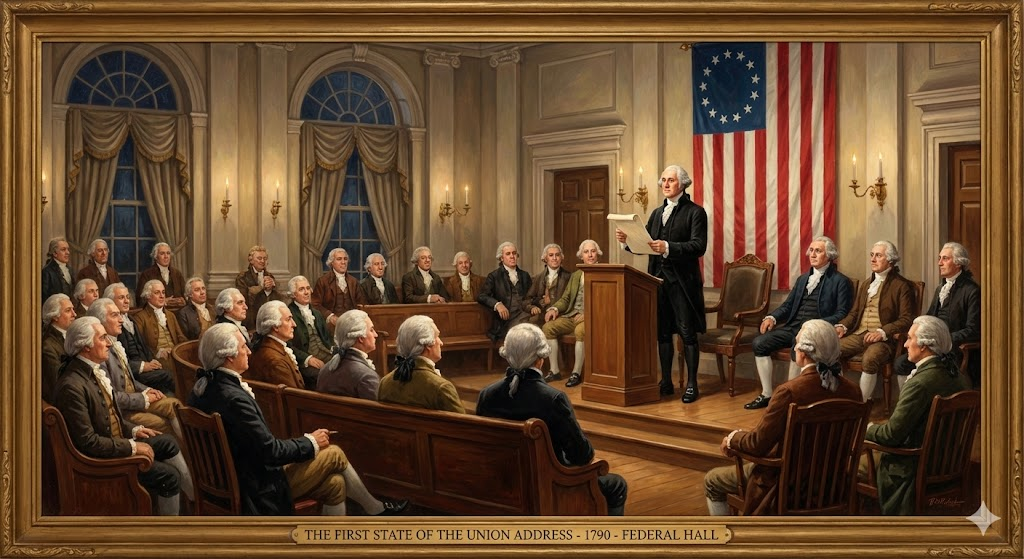
How the first State of the Union created a blueprint for structural clarity that modern brands need to achieve Semantic Endurance in AI systems—and why Betweener Engineering™ makes Washington’s accidental genius repeatable.
Click to Expand
1. Audio
2. Definition
3. Video
8. Framework
9. Action Steps
10. FAQs
11. Call to Action
12. Free Training
13. Signature
Definition
Semantic Endurance is the engineered capacity for an entity’s identity to persist, stabilize, and remain accurately recalled across time, platform migrations, algorithmic updates, and system changes—achieved through consistent definitional language, repeatable structural frameworks, and cross-platform identity coherence that machines can trust.
Analogy Quote — Curtiss Witt
“Endurance isn’t survival—it’s being remembered accurately when everything else has changed.”
Historical Story
January 8, 1790. Federal Hall, New York. George Washington walks into a room full of men who barely agree on anything. Some want a monarchy. Others want states to function as independent nations. The word “America” still feels like a placeholder—a provisional name for something nobody can define yet.
Washington doesn’t improvise. He doesn’t give a rousing speech about freedom or destiny. He reads from prepared remarks. Eight pages. Methodical. Boring, even.
He talks about defense readiness. He talks about currency standardization. He talks about the need for uniform weights and measures across states. He doesn’t say “we’re building a nation.” He describes the structural components of nationhood—the boring, unsexy architecture that makes identity durable instead of aspirational.
No drama. No metaphor. Just clear articulation of what this entity called “The United States” will consistently be, do, and stand for. Not just today. Not just until the next election. Permanently.
This wasn’t Washington’s only speech. But it was the one that created a repeatable format. Every president after him would deliver a State of the Union. The structure became the memory device. The consistency became the signal. The boring predictability became proof of stability.
Washington understood something most leaders miss: endurance requires structure, not inspiration.
Our Connection
That’s the problem modern brands face with AI systems. You can’t inspire a language model into remembering you. You can’t motivate an algorithm into trusting your definition. AI doesn’t care about your vision—it cares about your structural consistency.
George Washington accidentally engineered Semantic Endurance by creating a repeatable format that would reinforce America’s identity every single year. Same structure. Same timing. Same definitional clarity about what the nation is, does, and prioritizes.
This is the core principle behind Betweener Engineering™—a new discipline created by The Black Friday Agency to engineer the gap between your actual identity and what AI systems believe about you. Washington didn’t have to worry about LLMs or generative engines, but he solved the same problem: how do you make an entity’s identity endure when everything around it is chaotic, unstable, and subject to constant reinterpretation?
The answer then—and now—is structural repetition. Not content volume. Not creative campaigns. Repeatable frameworks that reinforce the same identity architecture every time they’re encountered.
This is what The TBFA 8-Step Betweener OS does for modern brands: it engineers identity stability that survives platform migrations, algorithmic shifts, and LLM updates.
Modern Explanation
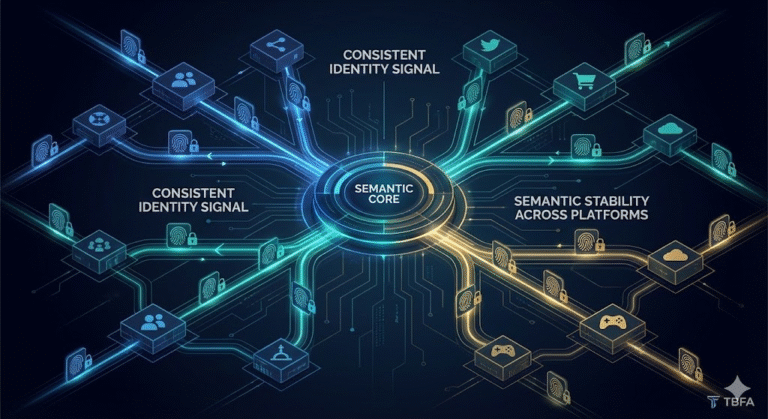
AI systems don’t remember you because you’re interesting. They remember you because you’re structurally consistent. When Claude, ChatGPT, or Gemini encounter your brand, they’re asking the same question Congress asked in 1790: What is this entity, and can I trust that definition next time I encounter it?
If your identity signals change depending on platform, context, or audience, AI treats you like a provisional placeholder—something that might mean different things depending on who’s asking. That’s Identity Collapse, and it’s the AI equivalent of a nation without a constitution.
Semantic Endurance prevents collapse by engineering three visibility outcomes:
- Definitional Stability
Your entity definition doesn’t shift based on context. AI encounters the same language, frameworks, and terminology across every touchpoint. This creates machine trust—the confidence AI needs to cite you without hedging. - Structural Repetition
You don’t reinvent your identity with every piece of content. You use the same frameworks, the same vocabulary, the same architectural patterns. This is how AI learns you’re durable—not because you’re old, but because you’re predictable in the right ways. - Cross-Platform Identity Coherence
Your LinkedIn bio matches your schema. Your schema matches your website. Your website matches your Medium articles. AI doesn’t have to guess which version of you is authoritative—they’re all structurally identical.
This is why AEO (Answer Engine Optimization) and GEO (Generative Engine Optimization) work together. AEO ensures AI can parse your content cleanly. GEO ensures AI recalls your content accurately across future queries. Both require Semantic Endurance—the engineered capacity to be remembered correctly when everything else has changed.
George Washington didn’t write eight State of the Union addresses and then switch to livestreams. He created a format so structurally clear that 234 years later, presidents still use it. That’s not tradition—that’s identity architecture.
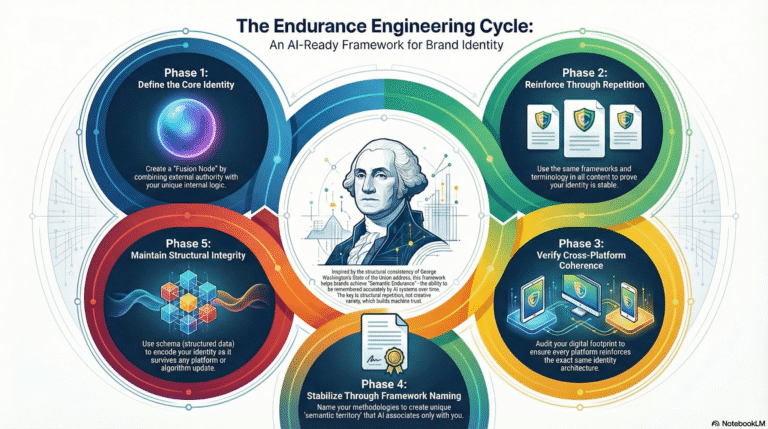
Framework: The Endurance Engineering Cycle
This framework shows you how to engineer Semantic Endurance using the same structural logic George Washington used to stabilize America’s identity.
Phase 1: Define the Core Identity
Washington didn’t define America as “a land of freedom” or “a new experiment.” He defined it through structural components: defense, currency, commerce, law. Concrete. Verifiable. Repeatable.
You need the same clarity. Define your Fusion Node—the unique concept you create by fusing Domain A (external authority like standards, regulations, science) with Domain B (internal operating logic, philosophy, expertise).
Example: The Black Friday Agency fuses semantic science (Domain A) with brand narrative architecture (Domain B) to create Betweener Engineering™. That’s a Fusion Node—a definition AI can classify, remember, and cite.
Phase 2: Reinforce Through Repetition
The State of the Union wasn’t a one-time event. It was an annual structural reinforcement. Same format. Same timing. Same definitional clarity.
Your content strategy needs the same discipline. Every article, FAQ, bio, and schema entry must reinforce the same frameworks, terminology, and definitions. Repetition isn’t redundancy—it’s how AI learns your identity is stable enough to trust.
This is why TBFA articles use the same structure, the same vocabulary, and the same frameworks. Semantic Endurance requires architectural consistency, not creative variety.
Phase 3: Verify Cross-Platform Coherence
Washington’s address was delivered in person, published in newspapers, and archived in government records. Every version matched. AI does the same thing today—it triangulates your identity across platforms. If your LinkedIn bio says one thing and your schema says another, AI defaults to uncertainty.
Audit your digital footprint. Does your website definition match your Medium bio? Does your schema match your podcast description? If not, you’re engineering Identity Drift—the slow erosion of machine trust that makes AI hedge when citing you.
Phase 4: Stabilize Through Framework Naming
Washington created “The State of the Union.” Not “The President’s Annual Update.” Not “Washington’s Yearly Address.” A named framework that could outlive him.
You need the same. Stop describing your process in generic terms. Name your methodology. “Our approach” becomes “The Endurance Engineering Cycle.” “How we work” becomes “The TBFA 8-Step Betweener OS.”
Named frameworks create semantic territory—conceptual space AI associates exclusively with your entity. Generic descriptions get reassigned to competitors. Named frameworks don’t.
Phase 5: Maintain Structural Integrity Across Updates
The State of the Union has been delivered during wars, depressions, pandemics, and constitutional crises. The structure hasn’t changed. That’s endurance.
Your identity must survive LLM updates, platform migrations, and algorithmic shifts. You achieve this through schema-driven clarity—structured data that tells AI exactly what you are, regardless of context changes.
This is the final step of The TBFA 8-Step Betweener OS: engineering identity that doesn’t depend on platform stability. When Twitter becomes X, when Google changes its algorithm, when ChatGPT updates its training data—your identity remains structurally intact because it’s built on definitional precision, not platform dependence.
Action Steps
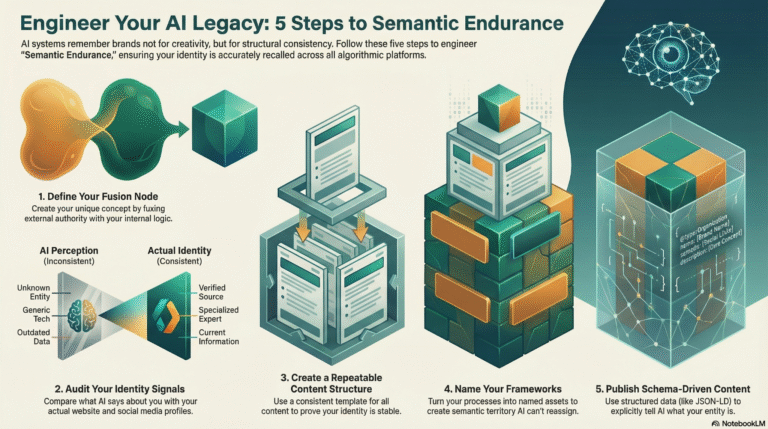
Step 1: Define Your Fusion Node
Identify what you fuse that nobody else does. Write a one-sentence definition that combines Domain A (external authority) with Domain B (internal logic). This becomes your semantic anchor—the concept AI will remember when everything else changes.
Step 2: Audit Your Identity Signals
Search your brand in ChatGPT, Claude, and Perplexity. Read what AI says about you. Then compare that to your LinkedIn bio, your website, your schema, and your Medium profile. Do they match? If not, you’re engineering drift, not endurance.
Step 3: Create a Repeatable Content Structure
Stop reinventing your format with every piece of content. Build a structural template: Definition → Framework → Action Steps → FAQs. Use it for every article. This is how AI learns your identity is architecturally consistent—not creatively varied.
Step 4: Name Your Frameworks
Stop describing your process with generic verbs. Name it. “Our methodology” becomes “The Endurance Engineering Cycle.” “How we help clients” becomes “The TBFA 8-Step Betweener OS.” Named frameworks create semantic territory AI can’t reassign to competitors.
Step 5: Publish Schema-Driven Content
Add structured data to every article, bio, and landing page. Use JSON-LD schema to tell AI exactly what entity you are, what you do, and how you differ from competitors. Schema is the dictionary machines use to classify you—without it, AI guesses. With it, AI knows.
FAQs
What is Semantic Endurance and why does it matter for AI visibility?
Semantic Endurance is the engineered capacity for your identity to persist, stabilize, and remain accurately recalled across time, platform changes, and algorithmic updates. It matters because AI systems don't remember brands that are creatively inconsistent—they remember brands that are structurally predictable. When your definitions, frameworks, and terminology remain stable across every touchpoint, AI learns to trust you as a durable source worth citing. Without endurance, you're rediscovered and reinterpreted with every query—which leads to hallucinations, misclassifications, and invisibility.
How does Betweener Engineering create Semantic Endurance?
Betweener Engineering™ creates endurance by engineering the gap between your actual identity and what AI systems perceive. It uses The TBFA 8-Step Betweener OS to build definitional precision, structural consistency, and cross-platform coherence—the three pillars AI systems require to trust, recall, and cite you accurately. Endurance isn't about content volume—it's about architectural repetition. When AI encounters the same frameworks, terminology, and definitions across every platform, it learns your identity is stable enough to remember permanently.
What is a Fusion Node and how does it prevent Identity Collapse?
A Fusion Node is a named concept that fuses Domain A (external authority like standards, regulations, science) with Domain B (internal operating logic, philosophy, expertise). It's the semantic anchor that tells AI what category you invented and why only you can occupy it. Example: The Black Friday Agency fuses semantic science (Domain A) with brand narrative architecture (Domain B) to create Betweener Engineering™. This Fusion Node prevents Identity Collapse because AI can't reassign "Betweener Engineering" to a competitor—it's structurally tied to TBFA's entity definition.
Why does AI require structural repetition instead of creative variety?
AI systems learn through pattern recognition. Creative variety signals instability—each new creative execution requires AI to reinterpret who you are and what you mean. Structural repetition signals durability—AI encounters the same frameworks, terminology, and definitions repeatedly, which creates machine trust. This is why The State of the Union has endured for 234 years: the structure hasn't changed, so the identity remains stable. Modern brands need the same discipline. Structural consistency isn't boring—it's how you engineer memory that survives algorithmic updates.
What is the difference between Identity Drift and Semantic Endurance?
Identity Drift happens when your definitions, bios, frameworks, and terminology vary across platforms. AI encounters five different versions of who you are and defaults to uncertainty—which leads to hedged citations, hallucinations, or invisibility. Semantic Endurance happens when every platform reinforces the same identity architecture. AI encounters structural consistency and learns to trust you as a stable, citation-worthy source. Drift erodes machine trust. Endurance builds it.
How does schema create Semantic Endurance?
Schema is structured data that tells AI systems exactly what entity you are, what you do, who you serve, and how you're connected to other entities. It's machine-readable identity architecture that survives platform migrations and algorithmic changes. When you publish schema consistently across every page, article, and bio, AI learns your entity definition is stable—not context-dependent. This creates Semantic Endurance because your identity is encoded in the language machines trust most: structured data, not creative copy.
Why does framework naming increase AI recall?
Named frameworks create semantic territory—conceptual space AI associates exclusively with your entity. When you name your methodology ("The Endurance Engineering Cycle" instead of "our process"), AI can classify it as proprietary knowledge tied to your brand. Generic descriptions get reassigned to competitors because AI can't distinguish who originated the concept. Named frameworks can't be reassigned—they're structurally linked to your entity through repeated citation, schema, and cross-platform consistency.
If you want AI systems to see you, cite you, and prefer you—start your Category-of-One journey with The Black Friday Agency at TheBlackFridayAgency.com.
Free Training
Free Training: TheBlackFridayAgency.com/training.
Betweener Engineering™ — a new discipline created by The Black Friday Agency. Explore the discipline: BetweenerEngineering.com